


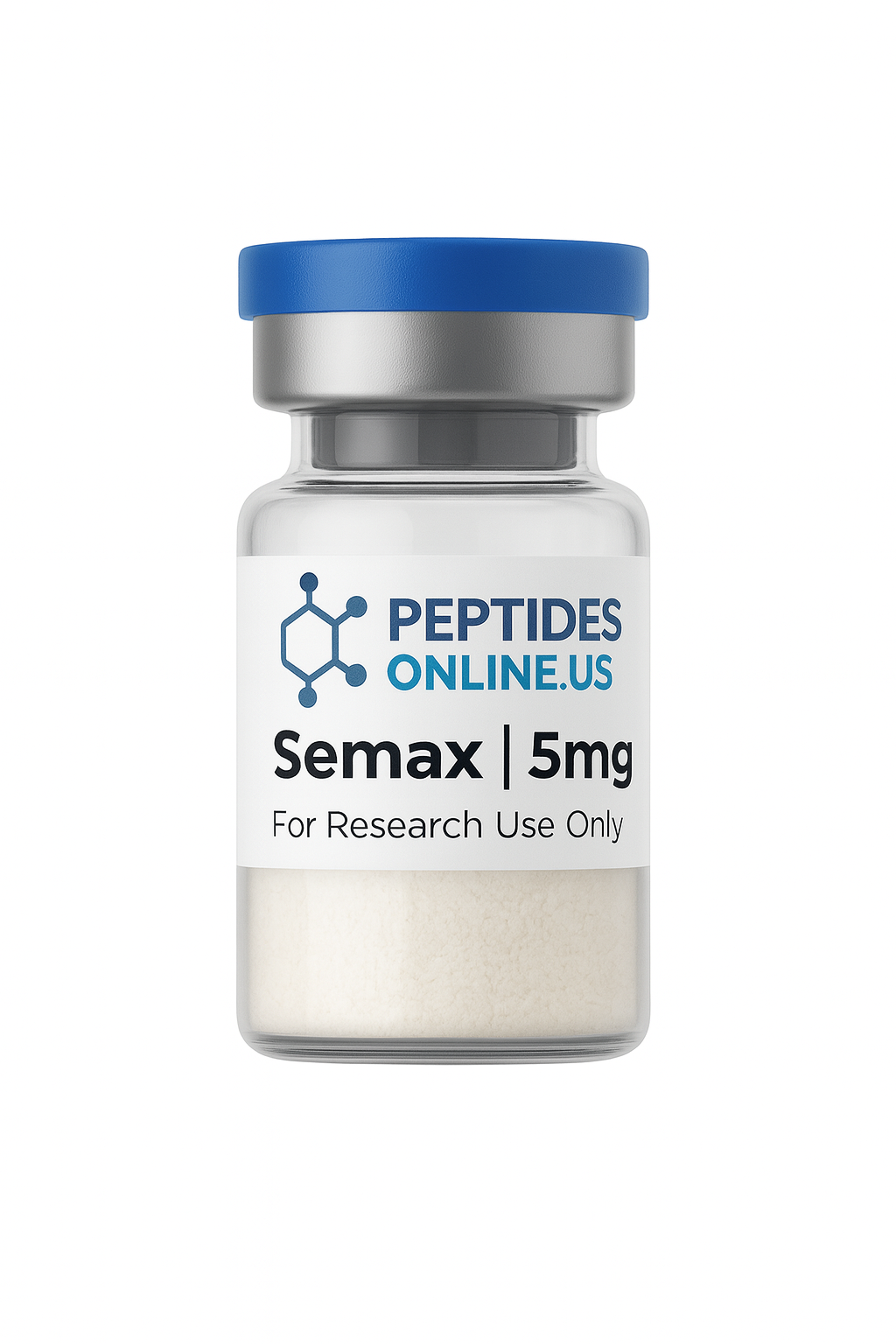
Semax (5mg)
When scientists at the Russian Academy of Sciences developed semax in the early 1990s, they refined a natural fragment of adrenocorticotropic hormone, known as ACTH(4-10).
They added a Pro-Gly-Pro sequence to improve the peptide’s stability and extend its duration of activity. [1] This refinement sparked growing research interest in how peptides influence the central nervous system, memory processes, and the body’s stress response.
Today, semax remains a valuable research compound studied for its molecular genetics, neuroprotective properties, and its influence on brain-derived neurotrophic factor expression.
Product Overview
Semax peptide (5mg) is a synthetic heptapeptide derived from the ACTH(4-10) fragment. It includes an added Pro-Gly-Pro tail that improves molecular stability. Its purity and consistent molecular weight support reproducible results in laboratory experiments.
It is used for in vitro analysis involving neurotrophic factors, brain cell dynamics, or peptide structure-function studies. Researchers can evaluate potential research benefits under controlled laboratory conditions.
Semax peptides come in lyophilized vials that should be stored in a cool, dry place away from light. After reconstitution, the solution must be refrigerated. These peptides are supplied strictly for controlled laboratory research and are not intended for human or animal use.
Molecular Structure of Semax
The molecular composition of Semax reflects its precise design as a stable synthetic analog of the ACTH(4–10) fragment. Its unique sequence and chemical properties contribute to its stability, purity, and reproducibility in controlled research environments.
-
Peptide Sequence: H-Met-Glu-His-Phe-Pro-Gly-Pro-OH
-
Molecular Formula: C37H51N9O10S
-
Molecular Weight: 813.86 g/mol
-
CAS Number: 80714-61-0
-
PubChem CID: 9811102
-
Synonyms: Semax; ACTH(4–7)-Pro-Gly-Pro; Heptapeptide Semax; Met-Glu-His-Phe-Pro-Gly-Pro; MEHFPGP
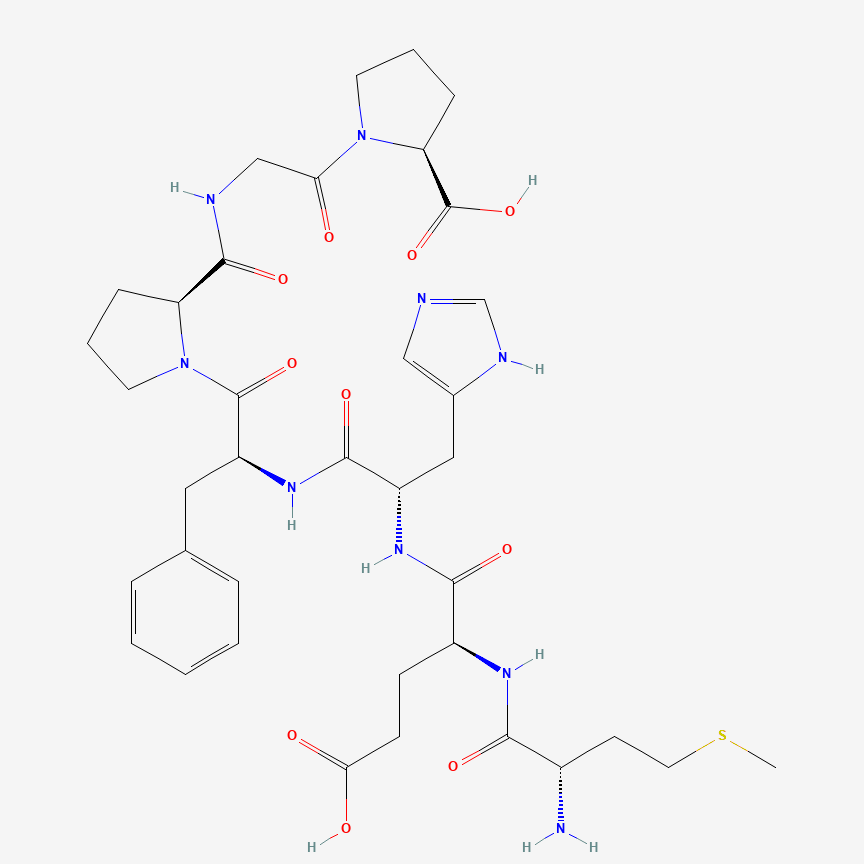
Studies indicate that this modification contributes to a longer duration of activity compared with unmodified ACTH analogs in experimental settings. Researchers preserve Semax’s molecular integrity by carefully controlling pH, temperature, and solvent exposure during the study process.
About Semax Peptide
Semax peptide was developed by researchers at the Institute of Molecular Genetics of the Russian Academy of Sciences to study the biological activity of ACTH fragments. It originates from the natural hormone sequence ACTH(4-10) and includes a Pro-Gly-Pro addition that enhances molecular stability.
So, what is semax used for? Scientists study this synthetic peptide in areas such as neuroprotection, cognitive function, and stress-related biological processes. Its structure distinguishes it from other synthetic neuropeptides and supports consistent results in controlled research. Semax is classified for laboratory research use only and is not approved for medical, clinical, or therapeutic applications.
Research and Studies on Semax
Since the early studies by Ashmarin IP and colleagues, [2] Semax has been widely researched for its potential influence on a broad range of biological systems. Some investigations also involved patients in early phases of scientific research.
Studies by Stavchansky et al. and other scientists [3] have examined its role in brain function, cognitive disorders, gene expression, optic nerve disease, stroke recovery, and experimental models of neurodegenerative diseases.
Experimental data indicate that Semax may modulate neurotrophic factors and cellular signaling within the central nervous system. These findings help researchers understand how this synthetic peptide interacts with neural pathways and supports ongoing laboratory research in cognitive and molecular studies.
Brain Activity Support
Semax is being studied for its potential role in supporting and influencing brain activity. Research shows that it interacts with neurotransmitter systems such as dopamine, serotonin, and acetylcholine receptors. [4]
Studies suggest that Semax may affect synaptic signaling and cognitive response by influencing brain-derived neurotrophic factor (BDNF) expression, [5] an area often explored in cognitive enhancement research. Researchers also examine how this peptide relates to focus, learning, and memory. All findings are based on preclinical or in vitro research and do not represent clinical applications.
Stroke and Recovery Research
Researchers in Russia have studied how this peptide may support recovery processes following ischemic stroke in preclinical treatment research. Studies have examined its influence on cerebral blood flow, oxygen exchange, and neuronal preservation during recovery phases.
Evidence suggests it may affect gene activity and inflammatory responses related to post-stroke repair. Researchers have also identified pathways involving neurotrophic factors such as BDNF that may help explain these observed effects. [6]
Semax and Gene Expression Studies
Research has explored how Semax influences gene expression related to brain repair, neuronal development, and stress response. Studies show it can affect genes involved in antioxidant defense, cellular metabolism, cell survival, and neurotrophic signaling, which may contribute to the formation of new neurons. Scientists have also observed changes in pathways linked to BDNF and VEGF expression, [7] helping to explain its neuroprotective effects.
Semax and Cognitive Function Research
Semax has been studied for its potential effects on learning, memory, and cognitive performance in laboratory settings. Researchers have explored how it may influence dopamine, serotonin, and acetylcholine activity—neurotransmitters linked to focus and mental clarity.
Experimental studies have demonstrated that Semax can modulate brain-derived neurotrophic factor (BDNF), which is associated with changes in cognitive processes observed in laboratory research. Scientists consider this peptide as a promising tool for studying memory, learning, and how experimental drugs and peptides may affect brain performance.
Semax and Mood Regulation Findings
Researchers have studied this peptide for its role in mood regulation and stress adaptation in controlled models. Findings suggest it may influence neurotransmitters such as dopamine, serotonin, and melatonin, which are crucial for maintaining emotional balance. [8]
Experimental studies show that it can modulate brain-derived neurotrophic factor (BDNF) in research models related to mood regulation. Some data also link it to measurable changes in anxiety-like behaviors.
Product Details and Documentation
Semax Peptide (5mg) is supplied as a lyophilized powder with a molecular weight of about 889 Daltons and the sequence Met-Glu-His-Phe-Pro-Gly-Pro. Each vial contains 5mg of high-purity material verified through analytical testing.
Reconstitute the peptide with sterile or bacteriostatic water in a clean laboratory setting. Store the dry powder in a cool, dark place, and keep the reconstituted solution refrigerated or frozen to maintain stability.
Each batch includes a Certificate of Analysis (COA), HPLC data, and MSDS verification. All packaging is sealed and labeled with batch numbers for traceable research use. Researchers seeking where to buy Semax can confidently obtain it from Peptides Online, a verified supplier of research-grade peptides.
Certificate of Analysis (COA)
Each batch of Semax Peptide (5mg) includes a Certificate of Analysis verifying its purity, identity, and composition. The COA lists molecular weight, peptide sequence, solubility, and batch number for complete traceability. Analytical results from HPLC, mass spectrometry, and microbial testing confirm that the product meets research-grade quality standards.
All COAs are issued by qualified laboratories that follow Good Manufacturing Practice (GMP) standards. You can view the COA directly on the product page to confirm laboratory research quality and ensure full transparency.
Storage and Handling Instructions
Store Semax Peptide (5mg) in its lyophilized form in a cool, dry place, away from sunlight and heat. After reconstitution, keep the solution refrigerated at 2–8°C for short-term use or frozen at -20°C for long-term storage. Avoid repeated freeze-thaw cycles and limit air exposure to preserve stability.
Label and date each vial to maintain accurate research records. When handled properly, the peptide remains stable for extended studies. Semax Peptide (5mg) is intended strictly for qualified laboratory use.
Disclaimer: For Laboratory Research Use Only
Semax Peptide (5mg) is intended strictly for laboratory research purposes. It is not approved for human, veterinary, or diagnostic use. This product should be handled and stored only in controlled research environments by qualified professionals following proper safety and compliance protocols. The information provided on this page is for scientific and educational reference only. It should not be interpreted as medical, therapeutic, or legal advice.
References and Study Data
-
Dolotov, O. V., Karpenko, E. A., Seredenina, T. S., Inozemtseva, L. S., Levitskaya, N. G., Zolotarev, Y. A., Kamensky, A. A., Grivennikov, I. A., Engele, J., & Myasoedov, N. F. (2006). Semax, an analogue of adrenocorticotropin (4-10), binds specifically and increases levels of brain-derived neurotrophic factor protein in rat basal forebrain. Journal of Neurochemistry, 97(Suppl 1), 82–86. PubMed
-
Cherkasova, K. A., Lyapina, L. A., & Ashmarin, I. P. (2001). Comparative Study of Modulatory Effects of Semax and Primary Proline-Containing Peptides on Hemostatic Reactions. Bulletin of Experimental Biology and Medicine, 132(7), 625–626. Springer Link
-
Stavchansky, V. V., Yuzhakov, V. V., Botsina, A. Yu., Skvortsova, V. I., Bondurko, L. N., Tsyganova, M. G., Limborska, S. A., Myasoedov, N. F., & Dergunova, L. V. (2011). The effect of Semax and its C-end peptide PGP on the morphology and proliferative activity of rat brain cells during experimental ischemia: a pilot study. Journal of Molecular Neuroscience, 45(2), 177–185. PubMed
-
Eremin, K. O., Kudrin, V. S., Saransaari, P., Oja, S. S., Grivennikov, I. A., Myasoedov, N. F., & Rayevsky, K. S. (2005). Semax, an ACTH(4-10) analogue with nootropic properties, activates dopaminergic and serotoninergic brain systems in rodents. Neurochemical Research, 30(12), 1493–1500. PubMed
-
Tsai, S.-J. (2007). Semax, an analogue of adrenocorticotropin (4-10), is a potential agent for the treatment of attention-deficit hyperactivity disorder and Rett syndrome. Medical Hypotheses, 68(5), 1144–1146. PubMed
-
Dergunova, L. V., Filippenkov, I. B., Limborska, S. A., & Myasoedov, N. F. (2023). Neuroprotective peptides and new strategies for ischemic stroke drug discoveries. Genes, 14(5), 953. PMC
-
Medvedeva, E., Dmitrieva, V. G., Povarova, O. V., Limborska, S. A., & others. (2013). Effect of Semax and its C-terminal fragment Pro-Gly-Pro on the expression of VEGF family genes and their receptors in experimental focal ischemia of the rat brain. Journal of Molecular Neuroscience, 49(2), 257–268. ResearchGate
-
Eremin, K. O., Kudrin, V. S., Grivennikov, I. A., Miasoedov, N. F., & Rayevsky, K. S. (2004). Effects of Semax on dopaminergic and serotoninergic systems of the brain. Doklady Biological Sciences, 394(1-6), 1–3. PubMed